Every other decision about a stone coaster — the artwork, the shape, the edge finish, the backing — sits downstream of one choice: the material. A slab of absorbent sandstone and a tile of polished marble both count as “stone coasters,” yet they behave like opposite products at the table. One drinks up condensation and holds a matte, full-colour print; the other repels water, shows a mirror finish, and quietly dulls the first time someone sets down a glass of wine. Getting the material right the first time is the difference between a coaster people keep and one that ends up in a drawer.
This guide walks through the stones you are most likely to be offered for a custom order, what each one actually does with a sweating glass, how each takes a design, and where each tends to fall down. The goal is to help you specify with intent rather than pick by photo.
The question that splits the field: absorb or block?
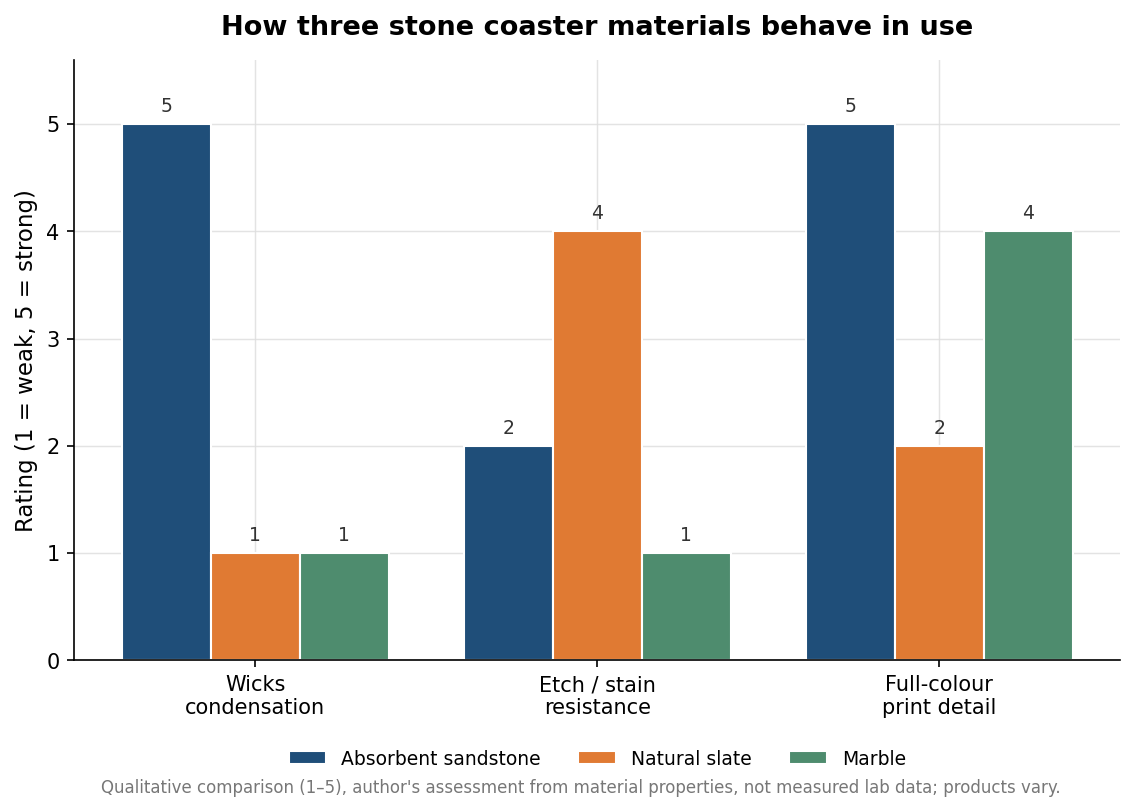
Stone coasters divide into two families, and the divide matters more than the rock’s name. Absorbent stones — marketed as sandstone or diatomite, and sometimes as “ceramic stone” — are porous by design. They wick the condensation off a cold glass into the body of the coaster, so the surface stays dry and no ring forms on the table. Barrier stones — slate, marble, granite, and most terrazzo — are dense and effectively non-absorbent. They stop a ring by putting a physical layer between the glass and the furniture, but the condensation has nowhere to go, so it pools on the surface and can run off the edge if the coaster has no lip or backing to catch it.
Neither family is better in the abstract. An absorbent coaster is the safer bet for a busy bar or a humid climate where glasses sweat hard. A barrier stone is the better call where the look matters more than the last drop of water, or where the coaster needs to survive years of rough handling. Deciding which family you want narrows the field before you ever look at colours.
Absorbent sandstone and diatomite: the sponge that prints well
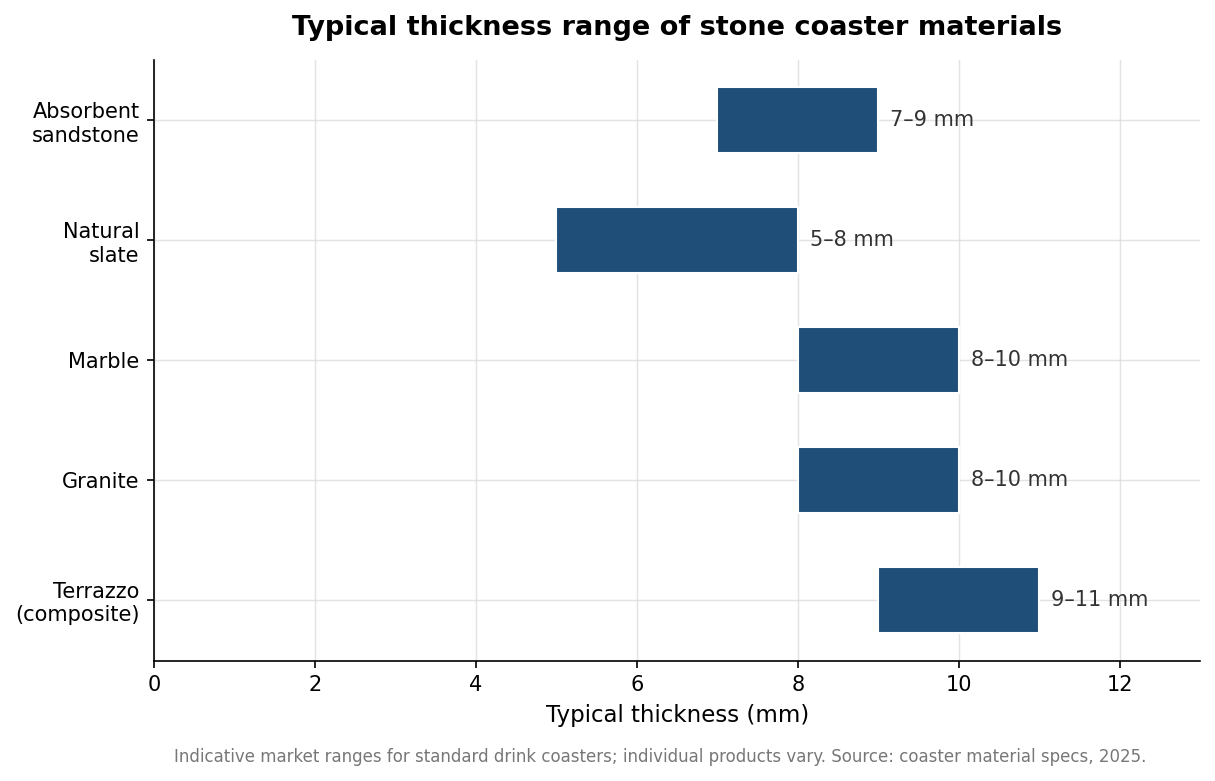
Absorbent coasters are usually a fine, chalky stone or a diatomaceous composite pressed into shape. A standard drink coaster runs about four inches across and, in this material, roughly 7 to 9 millimetres thick — enough body to hold a meaningful amount of water without feeling like a tile. The matte, light-coloured surface is the reason printers like it: it takes dye-sublimation and UV printing cleanly, so you get sharp, full-colour artwork edge to edge, which is hard to achieve on darker or glossier stones.
The trade-off is the same property that makes it useful. Porous stone that drinks water will also drink coffee, red wine, and cooking oil, and those stains are far harder to lift than the water it was designed for. A penetrating (impregnating) sealer helps, and it is the right kind of sealer here because it soaks in rather than forming a film — a topical film would simply cap the pores and kill the absorbency you paid for. Expect to reseal porous coasters periodically with regular use; every 6 to 12 months is a common cadence, though it depends entirely on how hard they are worked. If a supplier tells you an absorbent coaster never needs care, treat that as a red flag.
Slate, marble, and granite: the barrier stones and their quirks
Slate is a dense metamorphic rock with a naturally layered, riven face. It is tough, heat-tolerant, and forgiving of rough use, and it engraves beautifully: a laser burns the dark surface to a pale grey, giving crisp monochrome logos and text. What slate does not do well is full-colour photographic printing — the dark, textured surface fights against it — and because it does not absorb, a slate coaster needs rubber or foam feet and ideally a slight edge so pooled condensation does not migrate onto the table. Natural slate typically comes a touch thinner than absorbent stone, often in the 5 to 8 millimetre range, with edges left either natural (riven) or cut clean.
Marble is the luxury look, all veining and weight, and no two pieces are identical. It is also the most misunderstood stone at the table. Marble is calcium carbonate, which reacts with acids: wine, citrus, vinegar, and many cleaners will etch it, leaving a dull mark that is not a stain sitting on top but a change to the stone itself. Sealing reduces staining, but it does not stop etching, because a penetrating sealer does not put an acid-proof shell over the surface. Anyone buying marble coasters should know this going in and treat them as a considered, wipe-them-promptly product rather than a bar workhorse. Marble engraves to a bright frosted white and takes UV print well on its smooth face, so the decorative options are strong.
Granite is the hard case in the good sense: very dense, highly scratch- and heat-resistant, and far less reactive than marble. It is the most durable of the common choices and the least fussy about acids, at the cost of weight and a darker, busier surface that suits engraving and metallic-ink printing more than delicate full-colour work. Marble, granite, and terrazzo all tend to land in the 8 to 11 millimetre range, which is part of why they feel more substantial in the hand than a thin slate tile.
Matching the stone to the job
Start from where the coaster will live. For a high-volume bar or restaurant in a warm room, absorbent sandstone earns its keep by handling heavy condensation and reprinting cheaply when a run gets worn or lost; the staining risk is real but acceptable on an item you expect to replace. For corporate gifts and retail, where the coaster is a keepsake and the unboxing matters, marble or granite delivers the heft and finish people associate with quality — just pair marble with a clear word about acid care. For logo-forward promotional runs on a budget, engraved slate gives a premium monochrome result at a friendly price.
A few specification details apply across all of them. Confirm the backing: cork or EVA-foam feet protect furniture and stop the coaster sliding, and for barrier stones they also help manage the water that has nowhere else to go. Match the decoration method to the stone rather than the other way around — ask for engraving on slate and granite, and reserve full-colour UV or sublimation for the light, smooth surfaces that reproduce it well. On price, treat any figure as indicative and volume-dependent: absorbent sandstone is usually the most budget-friendly per unit, slate sits in the middle, and marble and granite carry a premium, with custom drink coasters commonly running from a few dollars each in bulk up to low double digits at single-unit retail. Nail down the material family first, then the specific stone, and the rest of the order tends to fall into place.