The material and the printing method get most of the attention when people order custom stone coasters, but the specification that decides whether an order actually works is quieter: who is using the coaster, and where. A wedding favor, a bar service coaster, and a corporate desk gift are three different products that happen to share a shape. Get the size, backing, and packaging right for the setting and the coaster does its job; get them wrong and you end up with a beautiful piece that slides around, sticks to the glass, or arrives in the wrong quantity for the event.
This guide walks through the three settings buyers order stone coasters for most often, and the spec choices that matter in each. The numbers below are typical ranges for natural stone products, not fixed rules, so treat them as a starting point for a proof and a physical sample rather than a promise.
Start with the drinkware, then the table
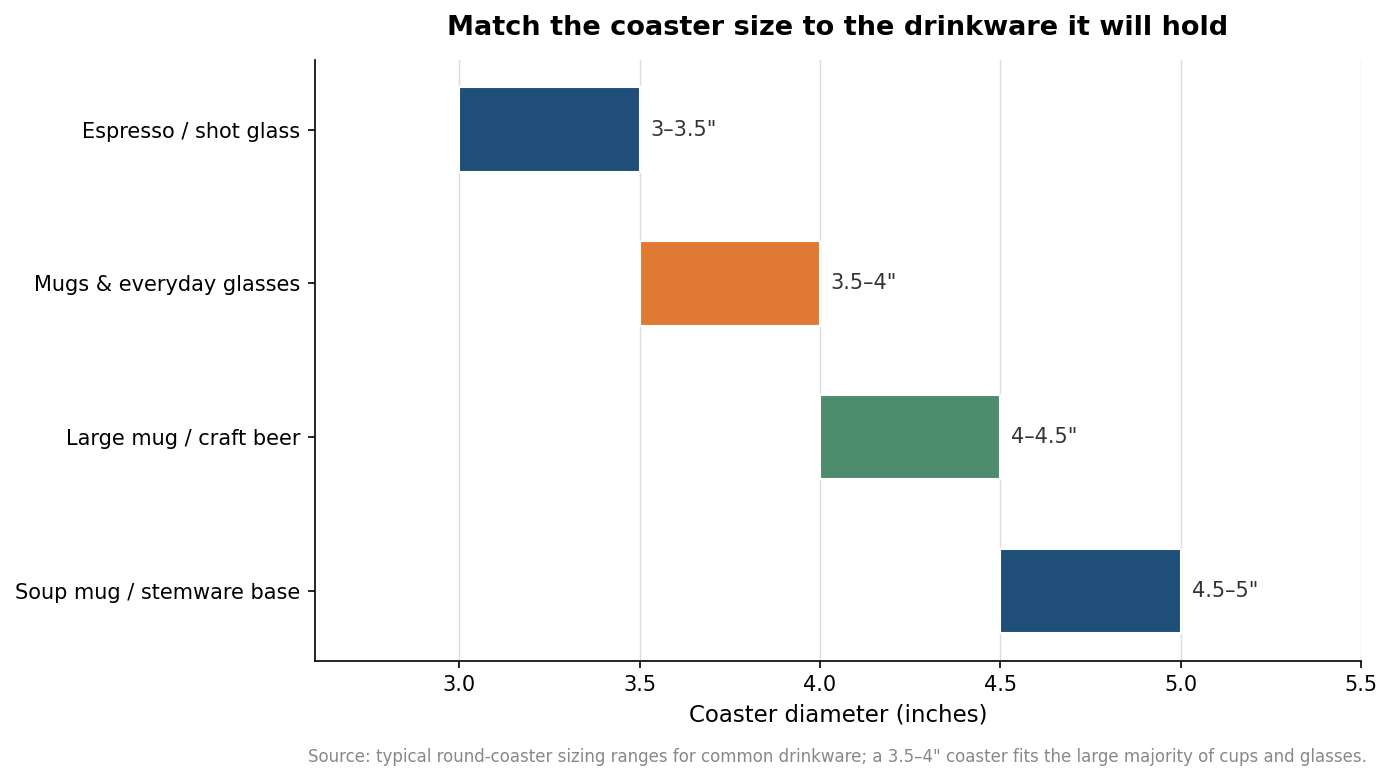
The single most common sizing mistake is choosing a coaster to look good on the table rather than to catch the drink that will sit on it. A coaster needs to be wider than the base of the glass by enough margin that condensation running down the side lands on stone, not wood. For most mugs and everyday glasses that means a 3.5 to 4 inch coaster, which covers the large majority of common drinkware. Espresso cups and shot glasses are happy on a 3 to 3.5 inch coaster; large coffee mugs and craft-beer glasses want 4 to 4.5 inches; and soup mugs or the wide base of stemware need 4.5 to 5 inches before the footprint is safe.
Square coasters read differently from round ones at the same nominal size because the corners add visual weight and printable area. A 4 by 4 inch square is the workhorse for hospitality and the easiest canvas for a logo, while 3.5 inch squares feel more modern and 4.5 to 5 inch squares become statement pieces. If a design has to hold a wordmark and a tagline, size up rather than shrinking the artwork to fit.
Weddings and events: absorbency and the favor set
For weddings and events the coaster is doing two jobs at once. During the reception it has to actually absorb condensation from cold drinks in a warm room, which is where natural sandstone earns its place: the raw, unsealed stone wicks moisture the way a sealed marble or glazed tile cannot. After the event it becomes a keepsake, so the presentation matters as much as the print.
That dual role drives two decisions. First, lean toward absorbent sandstone rather than a denser, sealed stone if guests will set down sweating glasses. Second, plan the packaging early. Favors are usually given as singles or pairs with a belly band or a small box, while a couple gifting a set to the wedding party wants boxed fours. Because natural stone is riven and hand-finished, expect visible variation in color and pattern from piece to piece; describe that as a feature in any accompanying card so guests read it as character rather than a defect. Order a working margin above your guest count, since events rarely come out even and stone cannot be reordered to match a dye lot.
Bars and restaurants: durability and the stick-to-glass problem
Hospitality is the hardest environment a coaster faces, and the failure people notice most is the coaster lifting off the table stuck to the bottom of the glass. That happens because a very absorbent, unsealed stone can form a brief vacuum with a wet, cold glass base. It is a real trade-off, not a defect: the same porosity that makes sandstone grab a glass is what makes it soak up condensation. If the venue serves a lot of iced drinks and the stuck-coaster look would embarrass the brand, a slightly less porous stone, a light sealing pass, or a design with a raised or textured surface all reduce the effect. If maximum absorbency matters more, accept the occasional lift and brief staff to expect it.
Durability is the other hospitality concern. Slate looks sharp but is relatively thin and brittle at the edges, so a chipped-edge slate coaster will keep chipping in a bus tub; sandstone is more forgiving. Whatever the stone, insist on a backing that protects both the tabletop and the coaster: felt or foam feet are quiet and gentle on finished wood, while rubber pads grip harder surfaces. Cork sheet backing splits the difference and adds a little cushion for stone that will be stacked and dropped repeatedly.
Corporate gifts: logo fidelity and boxed presentation
A corporate order lives or dies on how cleanly the mark reproduces on a rough natural surface. Fine serifs, thin rules, and small reversed-out type struggle on raw sandstone; a laser etch or a deep sandblast reads better on texture than a light print does. Send real vector artwork, confirm the minimum line weight the decoration method can hold, and always approve a physical proof on the actual stone before a full run, because a logo that looks crisp on screen can disappear into the grain.
Presentation is part of the gift. Corporate recipients expect a boxed set of four with tissue or a printed sleeve, not loose coasters in a poly bag, and the unit economics of a stone set sit well above a paper coaster, so the packaging investment is proportionate. Build in time for a proof round and a revision; a rushed corporate run that skips the physical proof is the most expensive way to learn that a gradient did not translate to stone.
Thickness, backing, and lead time: the specs that bite late
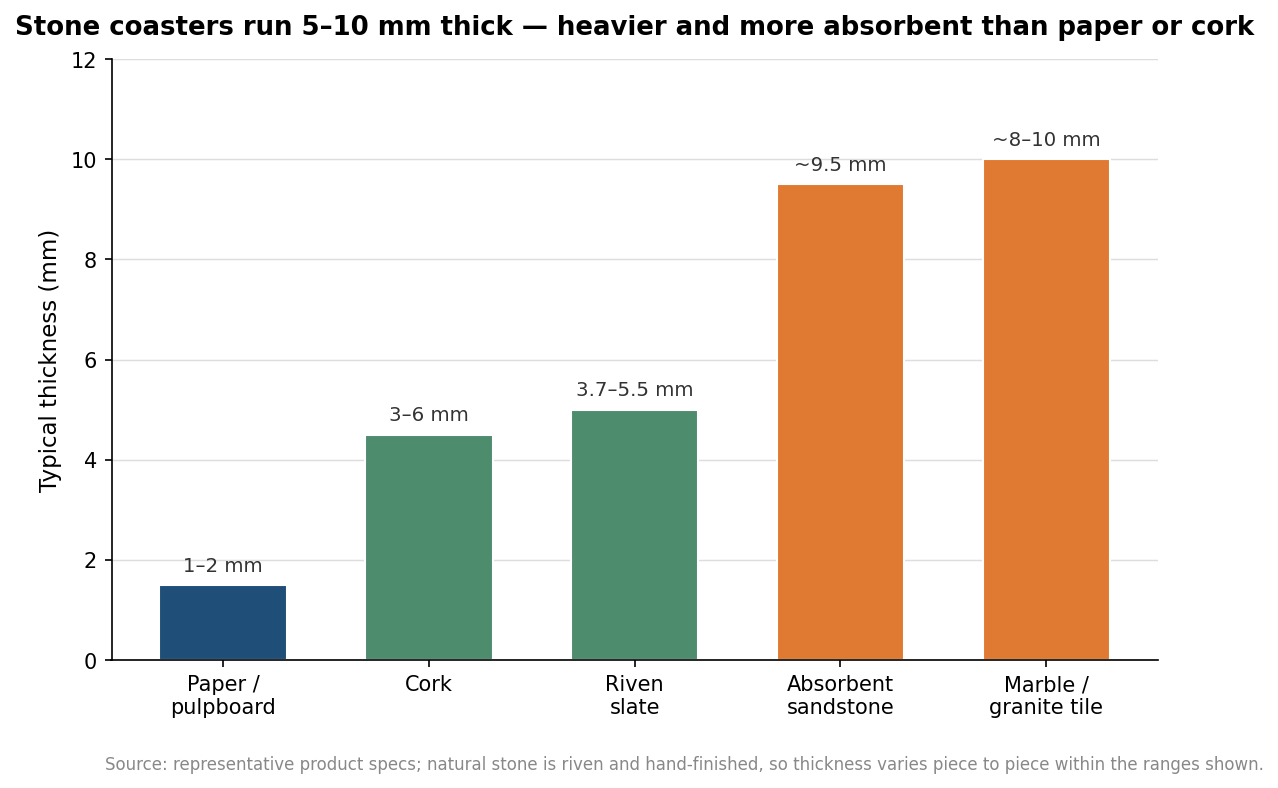
Thickness is where stone separates itself from every other coaster material. Paper and pulpboard coasters are 1 to 2 millimeters and cork is 3 to 6, while riven slate runs roughly 3.7 to 5.5 millimeters and absorbent sandstone sits near 9.5 millimeters, closer to half an inch once feet are added. Marble and granite tiles land around 8 to 10 millimeters. That heft is the point for a premium gift, but it also means shipping weight and box depth climb quickly on a bulk order, so factor both into the budget before committing to a quantity.
Two more specs tend to surface late and cause the most schedule pain. The first is backing: decide felt, foam, rubber, or cork up front, because retrofitting feet to a finished run is slow and looks it. The second is lead time. Custom decorated coasters generally move on a schedule measured in a couple of weeks once artwork is approved, and the approval step, not the production step, is usually what slips. Send print-ready vector files, ask for a physical proof on the real stone, and count the proof-and-revision loop as part of your timeline rather than a formality bolted on at the end. Do that and the specification that started as an afterthought becomes the reason the order arrives right the first time.