Two custom stone coasters can start life as the same slab of slate and end up looking nothing alike, because the decoration method changes almost everything about the result. One will carry a crisp gray logo burned into the surface; another will show a full-color photograph; a third will have a design you can feel with your fingertip. Choosing between laser engraving, sandblast etching, UV printing, and dye sublimation is really a choice about color, permanence, and the tactile character of the finished piece. This comparison lays out how each method works on stone, what it does well, and where it struggles.
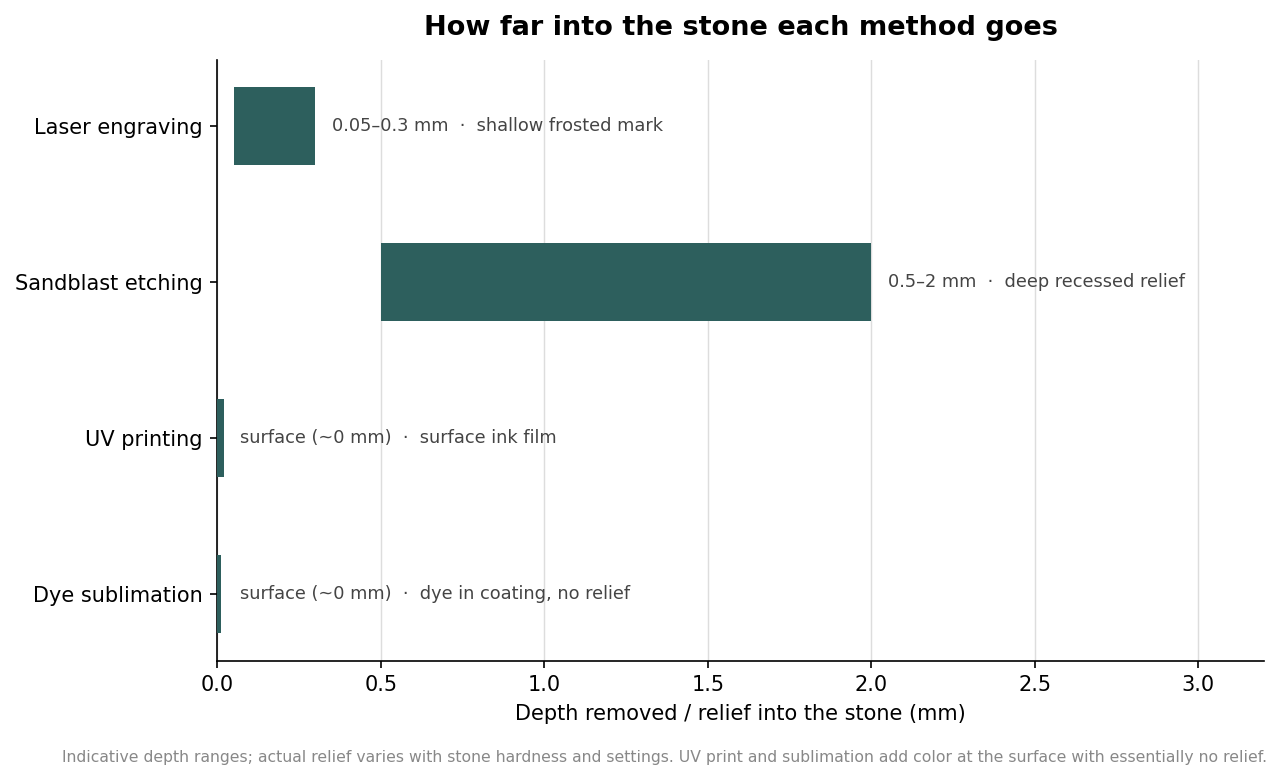
The first thing to understand is how differently these methods treat the stone itself. Engraving and etching remove material to create the design, so the artwork becomes part of the stone. Printing and sublimation add color at the surface and leave the stone flat. The chart below shows roughly how far into the surface each method reaches, which is the fastest way to grasp why they behave so differently over years of use.
Laser engraving: permanent, monochrome, precise
A laser engraver moves a focused beam across the stone and vaporizes a thin top layer, leaving a frosted mark where the surface has been micro-fractured. On dark, dense stone such as black slate, granite, or gray marble, that frosted mark reads as a light gray or near-white line against the dark background, which is why laser-engraved slate coasters have such strong contrast. The mark is shallow, typically a fraction of a millimeter, but it is genuinely part of the stone and will not wear off, fade in sunlight, or wash away.
The trade-off is color: laser engraving is monochrome by nature, so it cannot reproduce a full-color logo or a photograph. It excels instead at logos, monograms, text, and line art where crisp edges matter. On light or soft stone such as pale sandstone, the contrast largely disappears and fine detail can look muddy, so laser is a poor match for absorbent light-toned coasters. It shines on dark, hard stone and on short runs, because there is no stencil or coating to prepare before the first piece.
Sandblast etching: deep relief you can feel
Sandblasting drives an abrasive grit through a cut stencil to erode a recessed design into the stone. Because it removes far more material than a laser, the result is a deep, tactile relief, often half a millimeter to two millimeters down, with a soft matte texture inside the etched area. This is the traditional method for stone awards and memorials for a reason: the design is unmistakably carved, it catches light and shadow, and it survives heavy handling indefinitely.
Like laser work, sandblast etching is monochrome, though the recess can be filled with paint or enamel afterward to add a single accent color. The method carries a setup cost because each design needs a mask cut before blasting, which makes it better suited to larger runs or to pieces where depth and presence justify the extra step. For a single logo repeated across a boxed set of coasters, that mask cost spreads out nicely; for a one-off with fine photographic detail, it is the wrong tool.
UV printing: full color, straight onto the surface
UV printing uses a flatbed inkjet that lays down ink and cures it instantly with ultraviolet light. It prints in full color, including white, so it can reproduce photographs, gradients, and multi-color logos directly on the stone with no coating baked into the blank. For a brand that lives or dies by exact color matching, or for a design that includes an image, UV printing is usually the only method on this list that can deliver it.
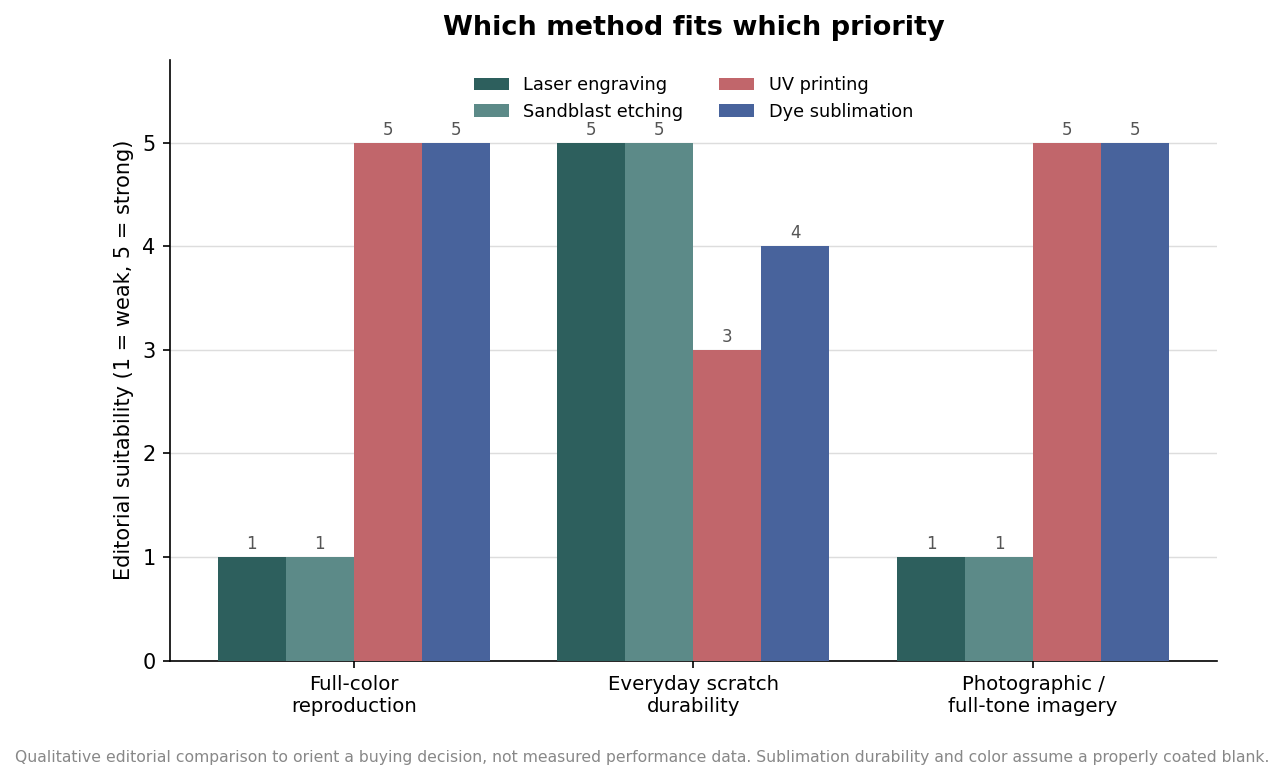
The honest limitation is that UV print sits on top of the stone as a thin cured film rather than becoming part of it. On a smooth sealed surface the bond is strong, but on a heavily used coaster the print can eventually show wear at the edges, and on raw porous sandstone the ink can sink unevenly and lose punch. A primer or a sealed surface improves adhesion considerably. The comparison below summarizes where each method lands on the priorities that usually drive the decision.
Dye sublimation: vivid color, but only on a coating
Dye sublimation turns solid dye into gas under heat and pressure so it infuses into a polymer coating, producing bright, durable, full-color images that are locked below the surface rather than sitting on top. It is a superb process for color and photographs, and because the dye lives inside the coating it resists the edge wear that can affect surface print. The catch, and it is a significant one for a stone coaster, is that sublimation needs that polymer coating to bond to. Natural, uncoated stone will not take a sublimation print at all. What is sold as a sublimation stone coaster is typically a coated blank, so you gain color and durability but give up the raw mineral surface and feel of true natural stone. If the appeal of your coaster is the honest texture of slate or sandstone, sublimation is not the right path; if you want a photographic image and a wipe-clean finish, it is excellent.
Matching the method to your stone and your run
The cleanest way to decide is to work from your three constraints in order: the stone, the artwork, and the quantity. Dark, hard stone with a logo or text points to laser engraving for its contrast and permanence. A design that needs depth and a carved, premium feel points to sandblast etching, especially across a larger run that absorbs the stencil setup. Artwork that depends on full color or a photograph points to UV printing on a smooth or sealed surface, or to sublimation if you are willing to use a coated blank for maximum color durability. Soft, absorbent, light-toned sandstone is the one case that narrows your options sharply, since it resists both crisp laser contrast and clean surface printing, and often does best with a bold, simple UV design and realistic expectations about detail. Decide the stone first and the method usually chooses itself.